Bowling Green Commercial Roofing FAQ
Find Out Which Roof Work Fits Your Building Before You Call
These Bowling Green commercial roofing FAQ answers cover permits, roof systems, repairs, inspections, cost factors and the towns we serve.
Straight Answers
Bowling Green Commercial Roofing FAQ by Topic
This Bowling Green commercial roofing FAQ starts each answer with the short version, then names the roof parts and buildings it applies to. Pick a topic to jump to it.
Commercial Roofing in Bowling Green
What does a Bowling Green commercial roofing contractor handle?
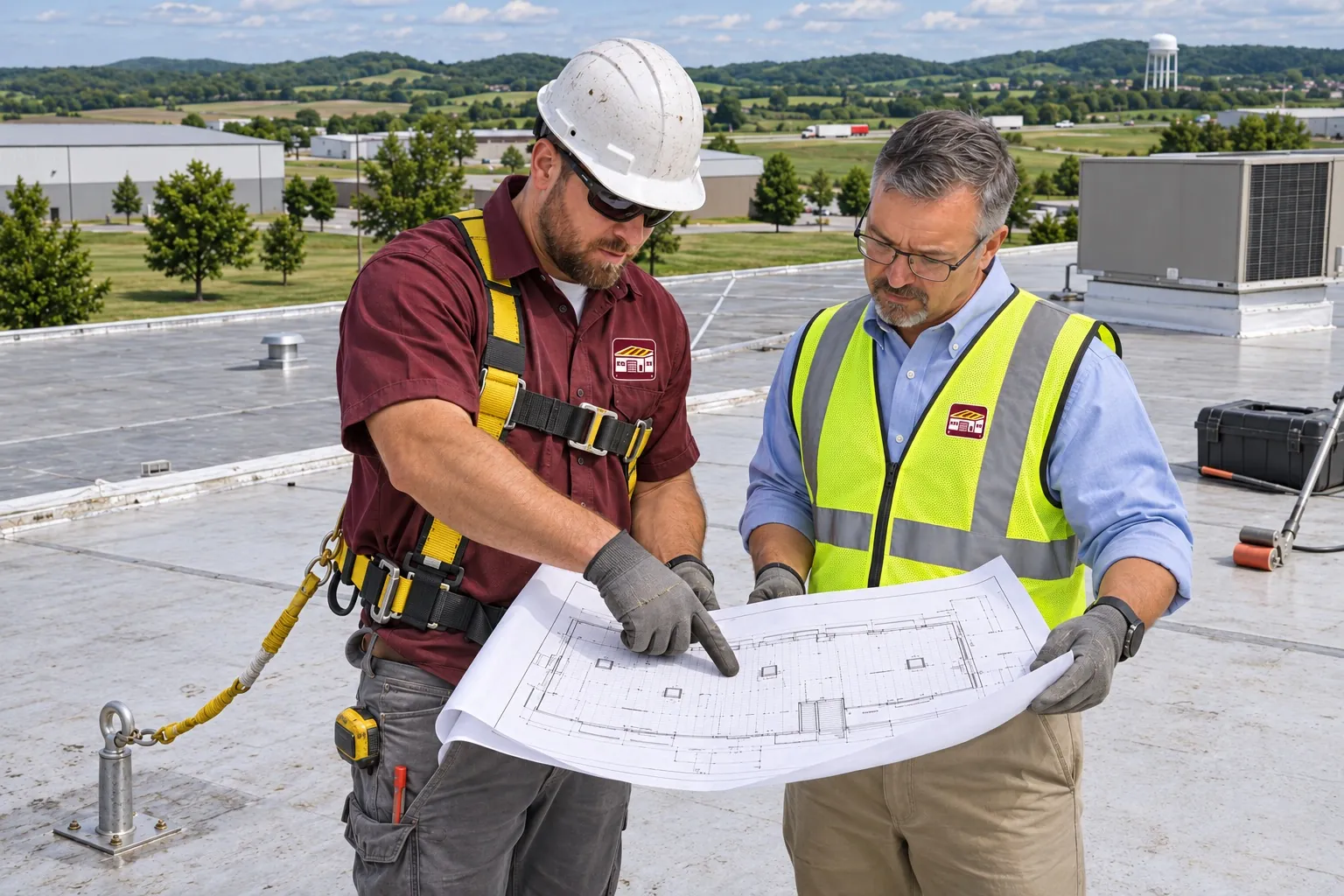
We handle every part of a commercial roof: new installs, repairs, full replacements, inspections and ongoing maintenance. In Bowling Green most of that work is on low-slope roofs over manufacturing plants, warehouses, retail and office buildings, schools, churches and downtown brick buildings, plus metal roofs on shops and farm buildings across Warren County.
Which roof systems do you install in Bowling Green?
We install TPO and EPDM single-ply membranes, flat roof systems with tapered insulation, and commercial metal roofs. The choice depends on the deck, the slope, the equipment on the roof, and how the building is used.
Do you only work on commercial buildings?
Yes. Our work is limited to commercial, industrial, institutional and agricultural buildings. We don't take on residential roofs.
Does Bowling Green require a permit for commercial roof work?
The City of Bowling Green requires a building permit to build, alter, repair or demolish a structure inside city limits, and roof replacement falls under that. Buildings outside city limits follow county rules. We confirm the permit for your address and scope before we start.
Repairs and Replacement
What are the first signs a commercial roof needs repair?
Water stains on ceiling tiles, damp insulation, blisters or bubbles in the membrane, seams lifting at the edges, and water that stays on the roof long after rain are the usual early signs. Inside, a musty smell near exterior walls can point to a slow leak at the flashing.
Is it better to repair or replace an older flat roof?
If the damage is in a few areas and the insulation underneath is mostly dry, repairing is usually the better value. If wet insulation runs across large parts of the roof, or the membrane is cracking everywhere, replacement costs less over time than chasing leaks. We decide that with moisture readings instead of guesswork.
Can a new roof go over the old one?
Sometimes. Building codes generally limit a roof to one recover layer over an existing roof, and the old roof must be dry and well attached. If there are already two layers, or the insulation is wet, a full tear-off is the right call.
What happens during a commercial roof replacement?
We protect the building and staging area, remove the old roof in sections, repair any damaged deck, install new insulation, then lay and seal the new membrane or metal. Edge metal, flashing and drains are finished last, followed by a final walk of the roof with you.
Roof Systems
Why is TPO popular on Bowling Green manufacturing plants?
TPO comes in wide rolls with heat-welded seams, which suits the large, open roofs on plants and warehouses. Its white surface reflects sun on long summer days. It also accepts welded repairs and add-on details easily when new equipment goes on the roof.
Where does EPDM roofing fit best?
EPDM fits buildings where the roof moves with temperature, where there is existing EPDM to match, and on schools, churches and offices with simple roof layouts. The rubber stays flexible through cold snaps and is easy to patch.
What is a flat roofing system made of?
A flat roofing system is more than the top membrane. It includes the deck, insulation (often tapered so water runs to the drains), a cover board, the membrane, and the edge metal, flashing and drains that tie it together. Problems in any layer show up as leaks on the surface.
Do you repair and install metal roofs on commercial and farm buildings?
Yes. We install new metal roofs, replace dented or rusted-through panels, reseal laps and fasteners, and fix ridge, trim and gutter details. That covers commercial shops, warehouses and agricultural buildings around Bowling Green.
What should plants know before industrial roof work?
Industrial roof work is planned around production. We review roof access, exhaust and process equipment, hot work rules, and any areas that must stay sealed, then stage the work so lines keep running. Roof walkways and equipment supports are part of the plan.
Bowling Green Commercial Roofing Questions Not Listed Here?
Call with the building type and the roof system if you know it. We answer from what we see on commercial roofs.
Inspections and Maintenance
When should I schedule a commercial roof inspection?
Schedule one in spring and one in fall, plus after hail or high wind. An inspection before buying or leasing a building is also worth doing, so you know the roof's condition before you sign.
What will a roof inspection report show?
It shows the condition of the membrane, seams, flashing, drains, edges and rooftop equipment, with photos. Where wet insulation is suspected, it includes moisture readings or a core sample. Repairs are listed by priority so you can plan the budget.
Why does commercial roof maintenance matter?
Most roof failures start small: a clogged drain, a loose pipe boot, a seam that opened after a cold night. Regular maintenance catches those before water reaches the insulation, which is where repairs get expensive.
Can maintenance be scheduled around our business hours?
Yes. Maintenance visits are planned for times that suit your building, and roof access is kept away from customer entrances and loading activity.
Cost and Estimates
What does a commercial roof cost in Bowling Green?
Price depends on the roof's size and shape, the system, the number of layers to remove, insulation and deck repairs, rooftop equipment, and access. A free estimate after a roof visit gives you a real number for your building and the options side by side.
How can I keep roof repair costs down?
Fix leaks early, keep drains and gutters clear, keep foot traffic to walkways, and have the roof inspected twice a year. Small repairs on dry insulation cost far less than replacing a wet section later.
Do you offer free estimates for commercial roofs?
Yes. The estimate is free, carries no obligation, and lays out the repair or replacement options for your roof with a price for each.
Areas We Serve
Which towns around Bowling Green do you cover?
We cover Bowling Green and nearby towns, including Glasgow, Franklin, Russellville, Scottsville, Cave City, Morgantown, Horse Cave, Auburn, Brownsville, Smiths Grove and Plum Springs. We also work in Bristow, Park City, Lewisburg, Adairville, Woodburn, Alvaton and other Warren County communities. Outside these areas, call us and ask.
Do you roof buildings in Bowling Green's industrial parks?
Yes. The industrial parks and business corridors around Bowling Green have large tilt-up and metal buildings with low-slope roofs. Those roofs suit TPO, EPDM or metal, and the work is staged around shifts and truck docks.
Do you work on older downtown Bowling Green buildings?
Yes. Downtown brick buildings often have parapets, internal drains, and several old roof layers. We check the masonry flashing and the deck closely, because those are the usual failure points on older roofs.
Do you serve Glasgow, Franklin and Russellville?
Yes. We roof plants, warehouses, retail buildings and offices in Glasgow, Franklin and Russellville, using the same inspection-first approach we use in Bowling Green.
Do you work in Smiths Grove, Plum Springs and Horse Cave?
Yes. We serve commercial and industrial buildings in Smiths Grove, Plum Springs and Horse Cave, including shops and metal buildings along the I-65 corridor.
Next Step
Take the Bowling Green Commercial Roofing FAQ to Your Own Roof
A roof walk turns general answers into a plan for your building. The estimate is free and carries no obligation.
(270) 236-5625